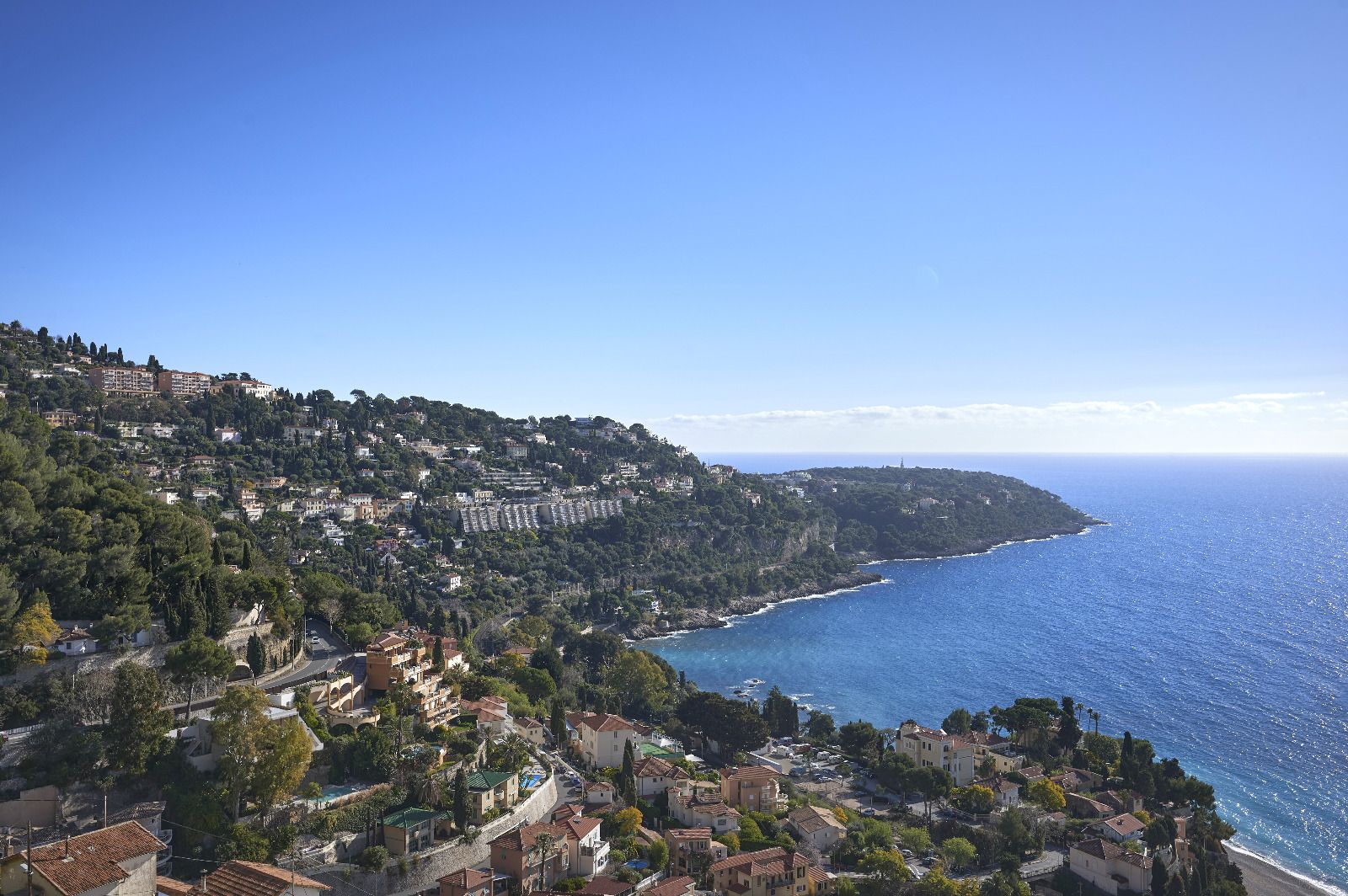
The neighbourhoods of Roquebrune Cap Martin
This commune in the Alpes-Maritimes is undoubtedly one of the most sought-after towns on the Côte d’Azur. Investors here are either business men and women, athletes, celebrities, or crowned heads of state. Within a tiny stretch of coastline, you find a cross-section of VIPs from around the world. Historically, this town in the Alpes-Maritimes has always been seen as a strategic location and a safe haven. The coastal effect and proximity to the Principality are at their peak — two factors that offer investors a degree of protection.
Historically, Roquebrune-Cap-Martin is a small village believed to date back to Antiquity. It is a very ancient settlement, and its medieval village bears witness to a thousand-year history. The Romans already occupied this area over two thousand years ago. But the real turning point for this small French commune was the rise of tourism during the 19th century. A dry climate, reputed to be mild for much of the year, and clear, limpid seawater — that was all it took to make this town a seaside resort renowned the world over. Today, Roquebrune-Cap-Martin has almost become a brand in its own right. It is a prestigious address where the grandest villas sometimes change hands for upwards of ten million euros.
What are the five neighbourhoods of Roquebrune-Cap-Martin?
1. The Cabbe Saint-Roman neighbourhood — prestige waterfront property at the gates of Monaco
Around 2,500 residents live in the Cabbe-Saint-Roman neighbourhood. Here, more than two-thirds of the housing stock (70%) consists of apartments, with one-third being individual residences (30% houses or villas). The median price per square metre in this neighbourhood hovers around €8,200 for apartments. The key to selling quickly is that the property must have been regularly maintained, and must also include private parking. This is a genuinely important point that should never be overlooked.
For reference, the postcode for the Cabbe Saint-Roman neighbourhood, as well as the rest of Roquebrune, is 06190.
This neighbourhood is divided into two parts. On one side is Saint-Roman — the part closest to Monaco. The consequence is clear: many Monégasques come here for the day, while others have chosen to settle there. Prices are naturally pushed upward and remain largely resistant to decline. Most sales are so-called “forced sales” (death, divorce, or bankruptcy), meaning there is relatively little movement or transaction activity in the area. Patience is essential, but so is availability and speed when an opportunity arises.
On the other side is Cabbé, a neighbourhood situated along the coastline and named after its famous beach (Plage du Buse). Behind this name lies a unique and highly sought-after location, which could almost be called “the gates of Monaco.” Property prices stand at approximately €8,200 per square metre for apartments and €11,000 per square metre for houses or villas with grounds or a garden. (As always, prices for houses and villas can vary considerably depending on plot size, location, and features.)
2. Cap-Martin — the most sought-after neighbourhood in Roquebrune-Cap-Martin
This neighbourhood is simply one of the most sought-after on the entire Côte d’Azur. Along this stretch of the south-eastern French coastline, you find buildings and villas with breathtaking, unobstructed views. This is where exceptional properties classified as prestige real estate are located, most of them set within private grounds. This neighbourhood is also sometimes referred to as the “Plateau.”
In terms of points of interest, this is where the Lumone tomb is found — a funerary monument dating from the Roman era, which once stood along the Roman road Via Julia Augusta. To visit these ruins, over 2,000 years old, simply head to number 41 Avenue Paul Doumer.
This is also where walkers stroll along the customs officers’ path, also known as the Promenade Le Corbusier. The neighbourhood is also home to a monument dedicated to Winston Churchill and another to Empress Elisabeth of Austria, as well as the Cap Martin public park, surrounded by Avenue Paul Doumer and Avenue Virginie Hériot.
The neighbourhood’s most iconic building is undoubtedly the Grand Hôtel du Cap Martin, constructed at the very end of the 19th century by the celebrated Georges Tesling, considered the architect of the French Riviera — a landmark that will convince even the most sceptical of the true singularity of this seaside resort.
Also located here are two of the finest villas: Villa Cypris and Villa Le Corbusier–Eileen Gray.
3. Carnolès
The Carnolès neighbourhood in Roquebrune-Cap-Martin is a central, modern district situated between Cap Martin and the beaches. It is a popular choice for those looking for an apartment close to the beach, restaurants, and the town centre. Carnolès is the most densely populated neighbourhood — in other words, the residential and commercial district with the highest number of residents. The reason is straightforward: its relatively flat terrain allowed for the construction of many apartment blocks during the 1970s. Here, everything is within walking distance and residents enjoy the easy, relaxed lifestyle of a seaside resort.
Carnolès is the town’s dynamic hub — its economic engine, where almost everything happens. Average apartment prices are around €6,500 per square metre, though top-floor properties can soar past €10,000 per square metre. House prices are also very high, averaging €11,500 per square metre.
4. Val de Gorbio
This neighbourhood, set back from the coast, takes its name from a small watercourse — the Torrent de Gorbio. Gorbio is also the name of a small hilltop village dating from the early 12th century, located a little further inland. The neighbourhood also contains caves where the presence of bones attests to human habitation since the Neolithic period.
Val de Gorbio is an elongated administrative district situated just above the Carnolès neighbourhood.
Its greenery is one of its appealing features. Because it faces east and sits back from the coastline, prices tend to be noticeably lower than in other neighbourhoods: €6,000 per square metre for apartments and €7,500 per square metre for individual houses.
This family-friendly neighbourhood is divided into two parts: the upper Val de Gorbio and the lower Val de Gorbio. It has a pleasant, authentic, family character.
5. Roquebrune — also known as the old village
The full official name of this neighbourhood is Village-Cros de Caste-Coupière-Mont Gros. It sits on a rocky outcrop perched nearly 300 metres above sea level. This is where the Grimaldi Castle, dating from 970 AD (10th century), is located. While the setting is picturesque and enchanting, it is not necessarily the neighbourhood most sought after by investors. The steep, narrow lanes give the “old village” a character all of its own.
The most coveted streets in the neighbourhood are Chemin de Menton and Chemin du Cros — two winding roads that hug the mountainside between sky and sea. Avenue des Agaves is also worth mentioning, where prices are slightly higher than in the rest of the neighbourhood. Average prices in this area are around €10,000 per square metre and can sometimes approach €15,000 for flawless, fully renovated properties.
As a curious aside, this neighbourhood sits directly above the Principality of Monaco. And right in the heart of the village stands the oldest tree in France, most likely dating from the first century AD. This remarkable olive tree is nearly 2,000 years old, standing fifteen metres tall, with an eighteen-metre spread and a circumference of almost twenty-four metres. Nearly felled in 1925, it was saved by the then-Minister of Foreign Affairs and still produces olives — known as Pitchouns. According to archaeologists, this tree is evidence of a settlement dating back to the Roman and Gallo-Roman eras. Roquebrune-Cap-Martin is a captivating place that has always known how to attract and retain its residents.
Further practical information about Roquebrune-Cap-Martin
The neighbouring communes include the lesser-known villages of Gorbio and Peille, as well as Beausoleil, Menton, and Monaco. From the heights of Roquebrune-Cap-Martin, there are sweeping views over the Monégasque Principality, which lies to the west of the commune.
The town’s official year-round population is 12,000 registered residents. However, as with all seaside towns, this figure can multiply four- or five-fold in summer — perhaps more.
How far are the nearest airports from Roquebrune-Cap-Martin?
The town is served by the airports of Nice, Toulon, and Marseille on the French side, and Genoa or Turin on the Italian side.
For those arriving at Nice Airport, it is possible to travel to Gare Saint-Augustin and take a train to Carnolès station (Roquebrune-Cap-Martin). By car via the motorway, the 35-kilometre journey from Nice Airport takes approximately forty minutes.


